The sanctum structure and tower of this small temple is contemporaneous with the Kailasanatha Temple at Kanchipuram and Shore Temple at Mamallapuram (early-8th c AD), placing it among the earliest Pallava-era structural temples. Continue reading

The sanctum structure and tower of this small temple is contemporaneous with the Kailasanatha Temple at Kanchipuram and Shore Temple at Mamallapuram (early-8th c AD), placing it among the earliest Pallava-era structural temples. Continue reading

Kanchipuram is one of two important centers of Pallava temple architecture in northern Tamil Nadu, the other being Mamallapuram Continue reading

I’m ending this Temple Run set not with photos of a temple but of a palace. This Nayaka palace dates back to the mid-17th c, and if the current architectural elements are close to the original, the contrast between this palace and Nayaka temples is quite profound. In particular, the amount of Islamic and even European influence on the palace’s architecture is immense, but the temples don’t exhibit any such influence, and when they do, the influence is very subdued (for example the vaulted roofs of the Nataraj temple in Chidambaram). In any case, these are beautiful palace buildings with a completely hybridized architectural style. Continue reading

The devotional energy inside the Meenakshi Amman temple is so intense that it could convert an atheist into a devotee of Parvati. Or maybe it felt that way only because I visited the temple one day before deepavali when the crowds were greater than usual (if they were), or maybe I had been building up this visit to the “symbol of Tamil culture” in my head. In any case, my experience of this temple was quite intense. One of the contributing reasons is definitely the labyrinthine nature of the temple. Continue reading

Kalugumalai is a village between Madurai and Kanyakumari in southern Tamil Nadu, and the site of an unfinished rock-cut temple, called Vattuvan Kovil, from the Pandya period (8th or 9th c) and rock-cut Jain relief sculptures. Only the shikhar (tower) of the temple is complete, with only the general shape of the mandapa cut out. I wonder if this work was started with the idea of making a much larger temple than indicated by the current form, since the shikhar could be the top of a much larger temple. Continue reading
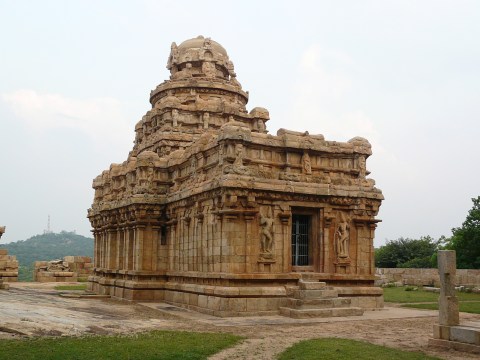
Set among a beautiful landscape of rock outcroppings jutting out of farmland, the Vijayalaya Cholishwara Temple is, despite it’s name, a 9th c Pallava temple. The temple and surrounding side shrines are built on one of the rock outcroppings. Unfortunately we reached the site in the late evening, so got just a few minutes of daylight to explore. Continue reading

In the interiors of central Tamil Nadu (though these days everywhere is relatively easily accessible by road) is the 9th c early Chola site of Kodumbalur, consisting of two small extant temples known as Muvarkovil, with beautiful proportions and sculptures. Continue reading

Srinivasanallur is a village some 40 odd kilometers from Trichy, and is the site for the early-10th c Koranganatha Temple. This is a small Chola temple built around 80 years before the huge Brihadeshwara temple at Thanjavur, but has stylistic similarities, such as a general cuboid design for the mandapa and sanctum structure, spaces of unadroned wall between pilasters, and a square two-story base (sanctum structure) for the shikhar (main tower), which in this case is very small compared to the base. Continue reading
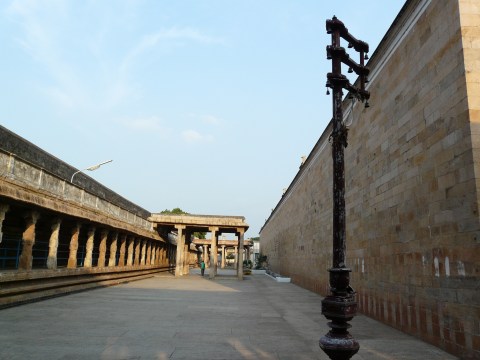
This is the smaller (comparatively) of the two main temples in Srirangam, and had a quiet feel to it when I visited, except for the central sanctum which had an intense prayer/chanting session going on. Continue reading

The island of Srirangam on the Kaveri river is immediately north of the city of Tiruchirappalli, and is the site of the Ranganatha (Vishnu) and Jambukeshwara (Shiv) temples. The Rangantha temple is a town unto itself, with the outer few concentric walled enclosures occupied with the city – residences, shops etc. One needs to pass through a few gopurams to get to the temple precints proper, and still there are gopurams and concentric enclosures to pass through to get to the central shrine. As such this temple is throbbing with life, not because it is crowded, but with a more laid back, everyday kind of life, as if this huge temple is part of the everyday of people who visit it. Continue reading
 Sarson ke Khet