Thursday Afternoon at Bakhtiyar Kaki’s Dargah

I visited Bakhtiyar Kaki’s dargah in Mehrauli on a Thursday, the busiest day at Sufi shrines, and here are a few images of the scenes and crowds, to complement the images and descriptions in the main dargah post.

Dilli Darshan: Mehrauli

Mehrauli is a large urban village that grew around the shrine of the 13th c. Sufi saint Bakhtiyar Kaki, much like Nizamuddin grew around the shrine of Nizamuddin Auliya (also 13th c. though a little later than Bakhtiyar Kaki). Kaki’s shrine was just outside the walls of Lal Kot, the fortified city within which the Qutb Minar is situated, and Mehrauli has grown right up to the edge of the now ruined fortifications. Continue reading

Dilli Darshan: Sayyid and Lodhi Delhi

I had thought that this leg of Dilli Darshaning was going to be of interest mostly only because it would take me to localities in south Delhi that I’d never been to before, while the buildings themselves would be nothing to write home about (or in this case write a blog post about). This is because common lore dictates that Delhi under the Sayyids and Lodhis became a “Necropolis”, a city filled with tombs and graves and nothing much else. Continue reading

Dilli Darshan: Firoz Shah Tughlaq’s Delhi

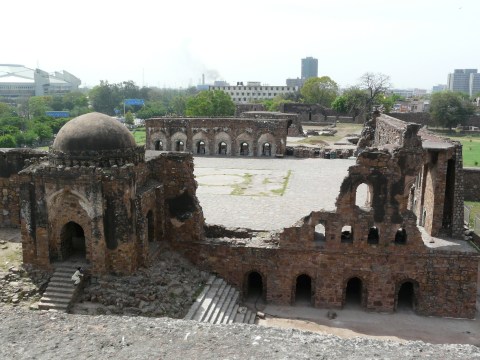
In the post previous to this one I had said that I’m not doing my Dilli Darshaning chronologically any more because most of the sites I’m visiting from this point on are very layered, in that they contain structures from various historical periods and architectural styles. So of course, the very next post (i.e. this one) has to be about sites with buildings from a very specific time in history and very specific architectural style, and which are much older than Purana Qila and Dilli Sher Shahi from the previous post! What to do? Nonetheless, here goes. :) Continue reading

Dilli Darshan: Purana Qila and Dilli Sher Shahi

At this point I’ve stopped trying to do my Dilli Darshan chronologically, so this post is about Purana Qila (literally Old Fort) and the remaining structures of what is known as Dilli Sher Shahi, which are from the 16th century, so I’ve jumped a couple of centuries. This is not too bad a thing, because most of the sites I’m going to be posting about from now on have structures from different historical periods, and thus have overlapping layers of building styles and types, much like the Nizamuddin site from the previous post. Continue reading

Comparing the Begampur and Jaunpur mosques

As always, click on image to go to its flickr set

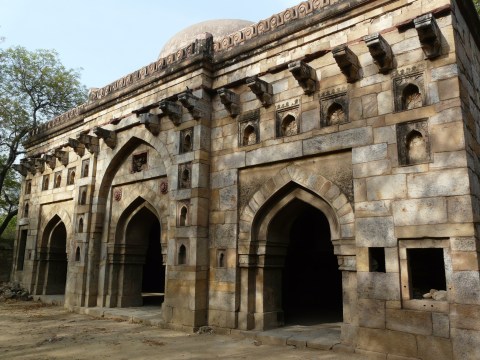
Just a small post to note possible similarities between the Begampur mosque’s pishtaq (the protruding central element on the facade) and the oversized pishtaqs of the Jaunpur mosques (such as the Atala masjid used as an example here). Both are Tughlaq era mosques (though Jaunpur is far away from Delhi) built in the mid-14th c. (Begampur) and late-14th c. (Atala). Of course the Atala mosque is much more ornamented and stylistically there are obvious differences, but the side-turret effect is similar, as is the batter effect, and to me the basic underlying design and massing is very similar. Hmm? Continue reading

Out with the old, In with the new … Part II

I went back to the site where I’d taken the Out with the old, in with the new photo in Dec ’06 to see if the tombs there were still standing and how the area around it had developed, and was pleased to find that the tombs are indeed still there, even though the area around is developing at a pace in keeping with the rest of Delhi! Maybe these tombs are on the INTACH listing and/or are protected by ASI, though that doesn’t seem to be much of a deterrent to the encroachment and demise of such monuments elsewhere! Continue reading

A brief history of Delhi, to explain it’s urban villages

This post explains the development of Delhi’s “urban villages” over the past few decades, and is a supplement to the Back to Dilli Darshaning post below.

To understand the idea of the urban village in Delhi, a short primer on the history of Delhi is in order. Some of you might have heard/read this stuff before at various venues, but I love to tell this tale, so here goes! Continue reading