Qadam Sharif And Nearby Qutb Road Structures

Qadam Sharif was originally built by Firoz Shah Tughlaq (14th c.) as a tomb for his son Fateh Khan, but the structure has been heavily altered since. The tomb, now located in the Pahar Ganj area, was enclosed inside an irregular kot (fortification) with gateways to the north and east. Little remains of these fortifications except the eastern gateway and parts of the northern gateway. Both were double gateways. Continue reading

Old Delhi’s Old Cinema Halls

While exploring Old Delhi and adjoining areas like Sadar Bazaar and Pahar Ganj, I’ve come across some deliciously intriguing decades-old cinema halls. Some are doing fine, some just getting along, while some seem to have shut shop or might be under litigation. This post is a visual exploration of those theaters – I haven’t gone into their histories, though I’m sure each and every one would reveal interesting stories with a little digging into. I’m assuming that these cinema halls all came up between the 1950s and 80s, though dates would have to be confirmed. Continue reading

Fatehpuri Chowk Teardown

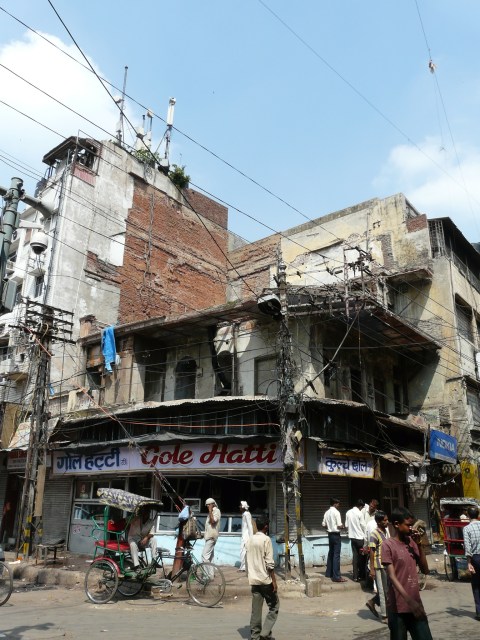
Fatehpuri Chowk was covered in my first post on Shahjahanabad, covering the Khari Baoli and Katra Neel areas. That was back in 2009, when I had visited Fatehpuri Chowk for the very first time. On turning off Chandni Chowk and experiencing Fatehpuri Chowk the first few times (before the place became familiar to me), I very clearly remember feeling that this was what a bustling town in India would have looked/felt like in the 1940s, 50s, 60s Continue reading

A Mosque (Okay Two) And A Dargah in Connaught Place

Mosque

There are many large and small structures within the area of “Lutyens’ Delhi” that predate the British imperial capital. This is not surprising since many villages existed in the area where the capital was built, and while most of these villages were razed, some of the religious structures – mosques, dargahs, temples and gurdwaras – were allowed to stand (and many, especially the gurdwaras, have grown in size and importance since then). Mosques were probably the most numerous religious structures, and are easily spotted today as their number and need for specific orientation made them difficult to incorporate into the new urban layout. They jut out onto roads (like the mosque on Janpath) and walkways (like the one on Baba Khadak Singh Marg) and occupy traffic circles (like on Kasturba Gandhi Marg and near Udyog Bhawan). Continue reading

Going, Going, Going, Gone!

Near the Vishwavidyalay metro station (Delhi University’s north campus station) lie a set of “minor” historic structures. These small structures, along what is now Brig SK Majumdar Marg, were ammunition stores constructed by the British in the early 19th century, when they (partly) moved out of the Kashmiri Gate area of Shahjahanabad to create the Civil Lines and cantonment (where DU’s north campus is now located). These ammunition stores would have been in or near the cantonment area at the time. Continue reading